
Restoration of Château de Belcastel
The Discovery of Belcastel
In 1973, the renowned architect Fernand Pouillon (1912–1986) discovered Belcastel and fell in love with the long-abandoned ruin. Throughout his brilliant career, Pouillon had been searching for a unique historic property to make his dream home. The moment he laid eyes on Belcastel, he knew it was the one. He purchased the castle in 1974 for 150,000 new francs (roughly €20,000 today). Rumor had it in the village that he paid the full amount in gold bars… Restoration work took eight years, from 1974 to 1982. The official inauguration took place on July 6, 1984.
The Materials
Pouillon sourced the stones needed for reconstruction, especially schist, from a quarry he had opened on a nearby hillside. For decorative masonry, he used limestone and the red sandstone of Marcillac. Chestnut wood was chosen for the floors. Although determined to use mostly original elements, Pouillon also opted for modern materials where needed for stylistic and practical reasons. The 450 steps in the castle, including the grand central staircase, were rebuilt in concrete. He also added large glass windows to protect interior spaces and preserve some original ruins from bad weather.
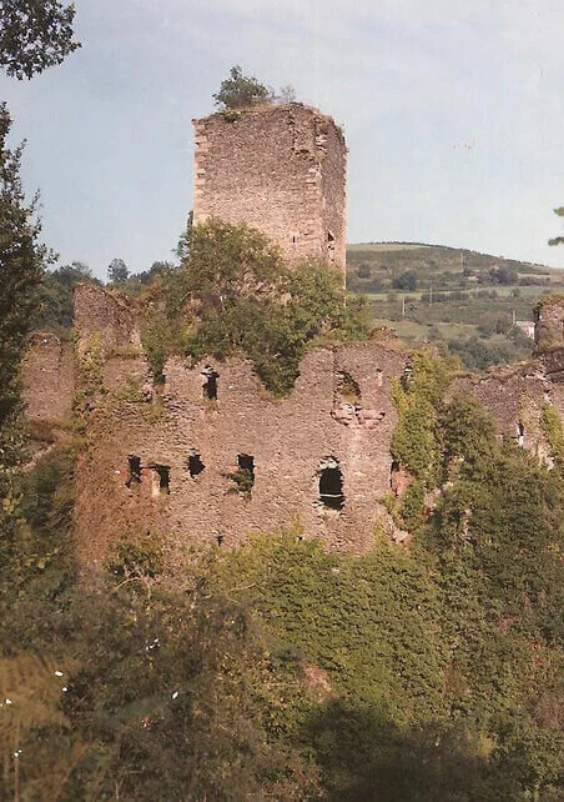
The castle ruins before renovation.
The Restoration
After acquiring the ruins, Pouillon took on the immense task of restoring the Château de Belcastel to its former glory.
He enlisted a team of about ten Algerian workers he had previously worked with in Algeria, paying their wages and expenses from his own pocket.
To understand what the castle had looked like before its decline, Pouillon carefully studied its remaining structure and compared it with other castles of the same era. He had to decide which architectural form to recreate: the original 11th-century fortress, the refined 15th-century chateau, or a reinvented hybrid combining historical and modern styles, a popular approach in the 1970s. But his vision changed radically after conducting further research. At the library in Rodez, he discovered an old book with engravings of the castle’s interior before its ruin, which provided valuable insight into the layout of many rooms. Fascinated by medieval architecture, Pouillon resolved to blend modern materials with stylistic details inspired by the 11th and 15th centuries.
An Architectural and Human Challenge
When Pouillon began the restoration, the castle was in ruins. Massive oaks were growing from the dungeon and in crumbling halls. The once-grand windows had become wide, gaping holes in collapsing walls. According to his wife Vera, his greatest challenge was keeping the surviving walls upright. He succeeded by keeping the ivy in place, its dense foliage helped support the structure. Pouillon and his team of masons and glassworkers used only traditional medieval construction techniques. Shunning cranes and modern tools, and braving the 40-meter cliff on the castle’s north face, they hoisted beams, vaults, and chimneys into place by hand, rebuilding the castle stone by stone, window by window.
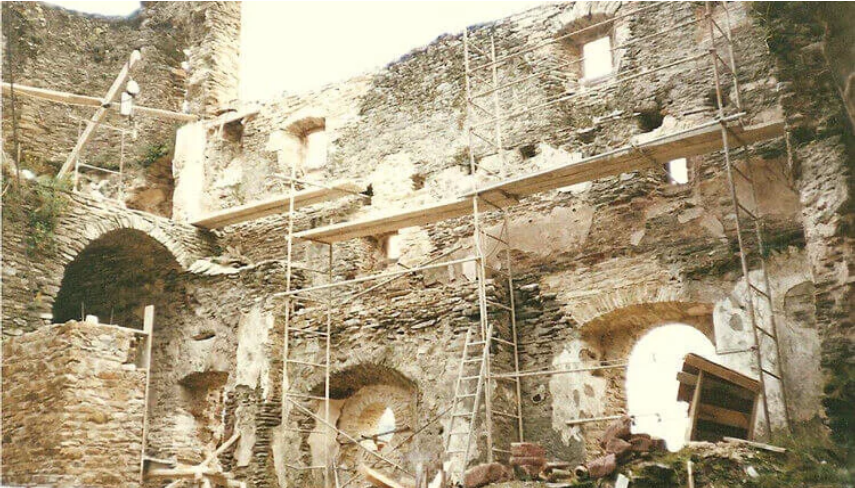
The inner courtyard during renovation.
A Masterpiece Reborn
Pouillon carefully recreated many original features of the castle, including the moats, the drawbridge, and the inner gate. It took over eight years for him and his team to transform a pile of rubble into a majestic château,
serving both as a private residence and a living tribute to history.
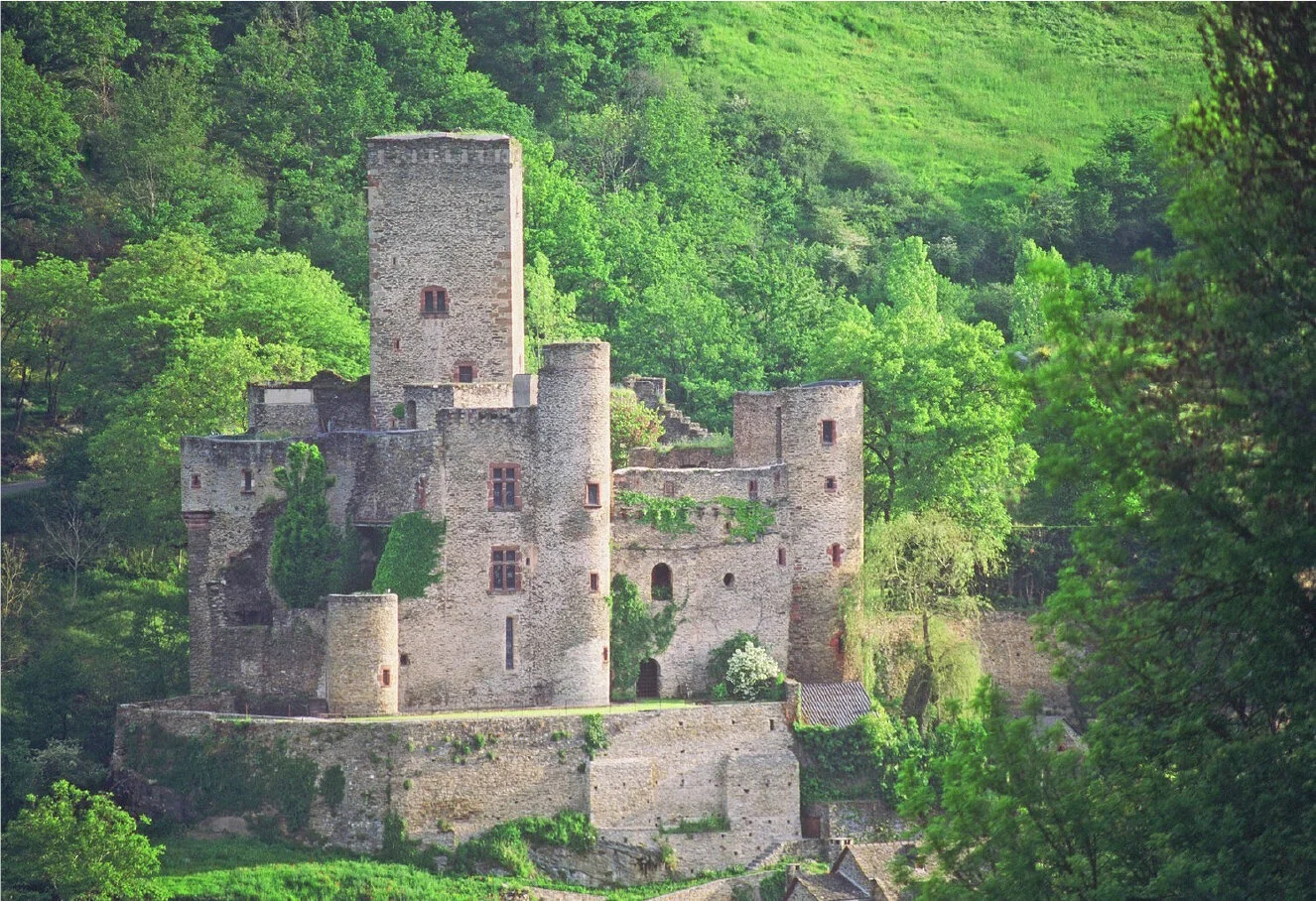
The Château de Belcastel after renovation.